





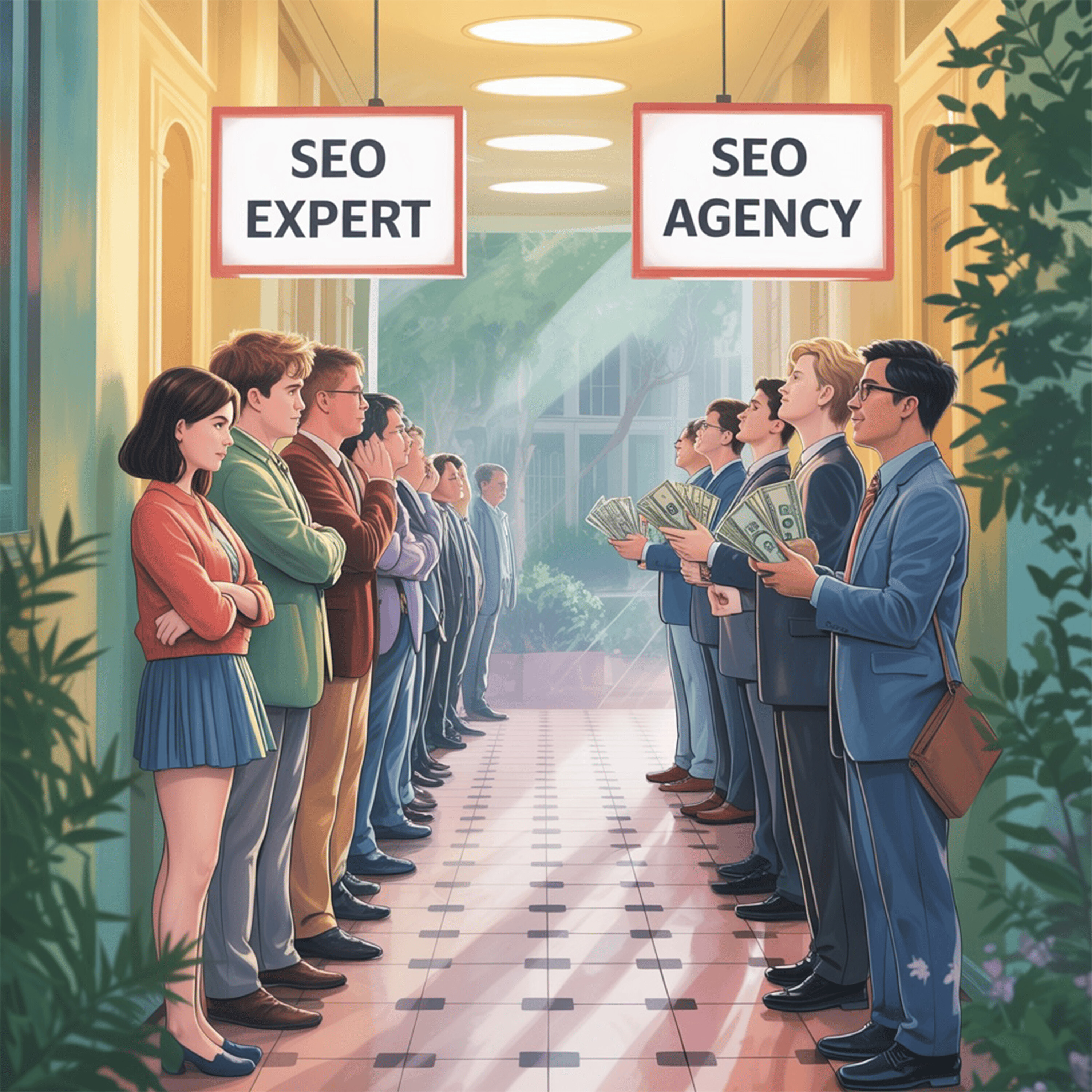
The episode discussion unpacks the distinct roles of each provider, revealing that an expert acts like a specialist "doctor" for targeted advice, while an agency serves as a holistic "coach" for comprehensive execution.
Show Notes
SEO Expert vs. SEO Agency: Making the Right Choice for Your Business (Decision Makers Edition) with Favour Obasi-ike with Favour Obasi-Ike | Sign up for exclusive SEO insights.
Episode Summary
Business decision-makers constantly face the challenge of choosing between a solo SEO expert and a full-service SEO agency to drive their online growth. In this episode, host Favour Obasi-ike is joined by guests Marc McIntosh, (G.A.) Pimpleton, and Jolanta Kissoon Young to demystify this critical choice.
The discussion unpacks the distinct roles of each provider, revealing that an expert acts like a specialist "doctor" for targeted advice, while an agency serves as a holistic "coach" for comprehensive execution. The conversation also ventures into the dark side of the industry, exposing common pitfalls and scams with firsthand accounts of fraudulent practices.
Finally, the group provides a concrete, actionable framework for vetting a trustworthy partner, emphasizing the non-negotiable need for proven results and the power of earned trust to ensure your SEO investment translates into real business growth.
Read New SEO Article: Is It Worth Hiring an SEO Expert in 2026? [Table Comparison]
Next Steps for Booking A Discovery Call | Digital Marketing + SEO Services:
>> Visit our Work and PLAY Entertainment website to learn about digital marketing services.
Key Takeaways for Business Leaders
First, define your need before you hire. The most critical first step is to align your business stage with the right provider. An SEO expert is ideal for startups or businesses needing strategic advice, specialized audits, or tactical guidance ("seeing where the needle is"). A full-service agency is better suited for mid-to-large companies that require an aggressive, multi-disciplinary growth strategy and hands-on implementation ("moving the needle").
Second, "receipts" are non-negotiable. Do not hire a provider based on promises alone. Demand tangible proof of their competence and impact. Ask for detailed case studies, analytics, and data—what G.A. calls "receipts"—that show where past clients in your industry started and where they finished. This data should clearly demonstrate an increase in revenue, reach, and other key business metrics.
Third, trust is earned through value. The most reliable and effective SEO partners are often those who don't rely on aggressive advertising. As Marc argues, trust is built over time. Seek out experts and agencies who freely educate their audience through podcasts, blogs, or online communities. This demonstrates genuine expertise, builds a foundation of trust, and proves they are more focused on delivering value than just making a sale.
Detailed Episode Breakdown & Timestamps
1. Introduction: The Core Dilemma
Starting at 00:00, host Favour Obasi-ike opens the discussion by framing the critical decision business owners face: whether to engage a freelance SEO expert or a larger SEO agency. He emphasizes the strategic importance of this choice, noting that it can define a company's digital foundation and shape its future growth trajectory.
At 01:15, Favour Obasi-ike provides an initial breakdown of the fundamental differences, describing an expert as a specialist focused on a specific problem, while an agency covers a comprehensive range of needs. He also introduces the idea that, under specific circumstances, the two can work together effectively.
At 03:30, two primary scenarios for collaboration are detailed: an expert can augment an agency's team with specialized skills for a particular project, or an expert can be brought in to provide a "third eye" perspective for an established in-house team, offering an outside view to improve internal processes.
With the core dilemma established, the discussion moves to the crucial task of matching your specific business needs to the right provider model.
2. Differentiating Roles: The Doctor vs. The Coach
Beginning at 05:00, the conversation highlights that to make a smart investment, you must first diagnose your own needs. This section provides a clear framework—the "Doctor vs. the Coach"—to help you distinguish between the need for tactical advice versus comprehensive execution and align your specific requirements with the right type of service provider.
At 06:45, the conversation compares the two roles using a clear analogy: the expert is like a doctor who diagnoses and prescribes, while the agency is like a coach who manages the team and executes the game plan. The SEO Expert, or "Doctor," acts as a consultant or specialist who provides tactics and strategies, helping you "see where the needle is." They typically cost between $500 to $3,000+ per month on average. The SEO Agency, or "Coach," provides a full team for execution and acts as the "backbone of your brand online," actively "moving the needle" for you with a robust, multidisciplinary approach.
At 09:10, Favour Obasi-ike explains the concept of an SEO agency acting as the technical "backbone" for a brand online. An agency is responsible for a wide array of needs, from generating traffic and performing technical fixes to assisting with branding, backlinks, and local SEO.
At 11:25, clear advice is given on when to hire each: an expert is ideal for those just starting out who need to learn the ropes and get strategic direction. In contrast, an agency is necessary for mid-to-large businesses or well-funded startups that require an aggressive, multifaceted growth strategy.
While understanding the ideal roles is essential, the real risk lies in the industry's dark side. The speakers now pivot to the critical red flags that can save a business from costly mistakes.
3. Industry Pitfalls: Scams, Red Flags, and Cautionary Tales
At 15:30, the conversation shifts to address the "bad rep" of the SEO industry, highlighting why business owners must be exceptionally vigilant. This segment underscores the importance of recognizing red flags to avoid wasting money, losing time, and protecting critical company assets like websites and data.
At 17:00, G.A. shares his negative experiences with agencies, explaining his preference for direct, one-on-one relationships. He recounts a client's horror story where a previous agency held their website and data hostage, making it nearly impossible to transition to a new provider and regain control of their own intellectual property.
At 20:15, Marc McIntosh offers a powerful anecdote about a new client who had been paying a significant sum for "SEO services" but did not even have Google Analytics or Google Search Console connected to their site—a fundamental flaw. He warns against providers selling overpriced, templated services and using fake bot traffic to manipulate reports and create the illusion of progress.
At 24:50, G.A. describes a common scam in his industry where companies buy recycled, low-quality leads from "SEO experts" who use impressive-sounding buzzwords like "quantum computing" to sell ineffective, boilerplate services that fail to deliver genuine clients.
Recognizing the scams is half the battle; the other half is proactively identifying a trustworthy partner. The conversation now provides a practical vetting framework to do just that.
4. Vetting a Partner: How to Find a Trustworthy Provider
Starting at 28:00, and armed with an understanding of the risks, this section delivers a practical toolkit for due diligence. Follow these systematic steps to move beyond a provider’s sales pitch and verify their true capabilities, establishing a successful and transparent partnership from the start.
At 29:30, the speakers collectively outline actionable steps for vetting any potential SEO provider.
First, ask probing questions. Favour Obasi-ike suggests asking specific operational questions to gauge professionalism and process, such as: "What is your tech stack?", "How do you handle sensitive data and passwords?", and "How do you work as a team?".
Second, demand "receipts" (proof of work). Synthesizing advice from the panel, this point stresses the need to see hard evidence. Demand what GA calls "receipts"—case studies, analytics, and performance data showing where clients started and finished. Additionally, as H advises, ensure these case studies explain the strategy behind the results, demonstrating their understanding of your industry.
Third, check their own fundamentals. Marc provides a simple but effective tip: audit the provider's own website for basic SEO health. If they have fundamental errors like multiple H1 tags (Mark's example) or an outdated copyright date (Jolanta's example), it’s a major red flag.
Fourth, verify their authority. Look for tangible proof that they are a genuine expert in their field. A credible provider often has a presence on platforms like LinkedIn, hosts a podcast, writes a blog, or runs a community where they actively share knowledge and engage with their industry.
Fifth, prioritize referrals and earned trust. Marc makes a compelling argument that the best partners are found through trusted referrals, not advertisements. He advises following potential experts over time. Those who consistently teach and give value freely are building genuine trust, making them a much safer and more reliable choice.
A thorough vetting process is the best defense against industry scams and serves as the foundation for a fruitful, long-term relationship.
5. Final Thoughts & Resources Mentioned
At 45:00, the final segment wraps up the discussion by covering specific tools and platforms that can aid in SEO efforts. This reinforces the core idea that successful SEO is not a one-time fix but an ongoing, dynamic process of learning, implementation, and adaptation.
At 46:15, the discussion touches on leveraging specific platforms for greater reach. In response to Jolanta's question, Favour Obasi-ike explains that Pinterest is a powerful visual search engine, not just a social media platform. Because the lifespan of a "pin" is 3.5 months to 5 months (compared to 19-72 hours for an Instagram post), content published there continues to drive traffic and build authority for a brand long after it's posted.
At 52:30, the tools and platforms mentioned throughout the episode include: ClickUp, Zoom, Google Search Console, Google Analytics, ChatGPT, LinkedIn, Clubhouse, and Pinterest.
At 55:00, Favour Obasi-ike closes the episode with a final call to action, encouraging listeners to connect with him directly via the link in his bio to turn the insights from the conversation into concrete action for their businesses.
See Privacy Policy at https://art19.com/privacy and California Privacy Notice at https://art19.com/privacy#do-not-sell-my-info.














Comments & Upvotes